
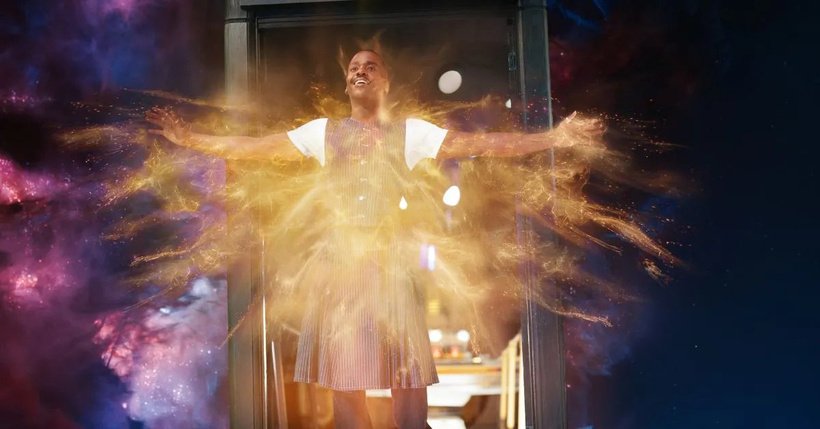
Well, Doctor Who Series 15 has come to a close with The Reality War, and we don’t know what is going to happen next.
But before we spend time ruminating over the mind-bending regeneration, James and Magnus are here to discuss The Reality War.
After eight episodes, which kicked off with Robot Revolution, it is the end of an era.
Shownotes
Doctor Who: The Reality War on BBC iPlayer and Disney+.
Patreon benefits
Supporters of the podcast on Patreon got this week’s show ad-free and early. Sign up to enjoy the same benefits.
Get in touch
Subscribe to our podcast? Then head to Apple Podcasts to leave a rating and review. Any new reviews will be read out.
Not on Apple Podcasts? Leave us a review somewhere else, send the link over on Twitter or Facebook or editor@allversions.kasterborous.co.uk, and you’ll get a mention.
Transcript
This week, something new: the episode’s full generated transcript.
James McLean: Welcome to the, last of our eight, episodes into the season two of Doctor who’s bir regeneration phase. I guess. this is not the podcast that it was planned. We were going to go with, John Kenneth Meu again, and he was unable.
Magnus: A proper guest.
James McLean: I wasn’t saying a proper guest. I was saying a scheduled guest. Because I wanted a scheduled guest who wanted to be here, rather than an unscheduled guest who is reluctant and slightly prickly to be doing a podcast. But I do, by good fortune, have Magnus in my vicinity. So we are literally in the same room. So apologize for this sort of echo equality. You’ll get to this. But it’s not room that we plan to record in. But I could’t not take the opportunity to have, I guess for the last episode, no matter how prickly they might be about being here and being held hostage. She’s being held. Being held hostage. You hear that? Hostage. so, yes, we’ve just, actually, we’ve just literally finished the last episode. The reality war Magnus didn’t see last week, obviously saw the interstellar, song contest, because we recorded that. so, yeah, I’m quite genuinely, I’m always very happy to be chatting to Magnus Pence. They are in my space at this moment. Not many people come into my space. I don’t like them in my space. And quite honestly, most people don’t want to be in my space either.
Magnus: Hostage.
James McLean: Hostage. Exactly. So we’re not going to go on for massively long on this because as I said, it’s almost 11:00 at night. But we wanted to record something and given also Magnus might be a slightly more prickly slash feel. Hostage. Because I have made a watch the episode as well. That face that you can’t see is not good. but I don’t think that’s about the episode. That’s about me making them watch it. So I’m just going to go straight to it. You didn’t see last week’s episode. We did have a quick talk about it. There was zero recap, which surprised me.
Magnus: Yeah. So, I mean, it felt like they were wrpping a lot of. A lot of things, A lot of things, happening in this episode.
James McLean: Because it’s weird because in a way, when you came on to sort of help do some of these podcasts with me was pretty much the start of his era. And so you ve kind of followed through.
Magnus: We watched the episode, the Giggle.
James McLean: By Regenerative, I think.
Magnus: Did we watch the first one.
James McLean: Yeah. We watched. We watched the Christmas one because I remember I. You were reluctant to that as well. I remember the different. Different colors of reluctance. So clearly I’m a spectrum of reluctance. You are a spectrum of reluctance, which is normally the mantle I would take for myself. But somehow in this dynamic, I utterly lose it.
Magnus: Magnus wins every time.
James McLean: It does seem that way. so, yeah. Again, did you. I mean, I found it. I mean, it was.
Magnus: You said, and I quote, wow, this episode really does somehow keep going.
James McLean: Yeah. Think, I think, to be specific, I said it just keeps wobbling on.
Magnus: That’s it. Keep wobbling on. Which I thought it was a little harsh.
James McLean: It did feel like you just didn’t know quite where in the episode structure you were. If just kind of wobbled onwards towards the end.
Magnus: It didn’t have the structure I was expecting.
James McLean: No, same.
Magnus: Expecting the crescendo to be the death of the brani.
James McLean: Yeah. Yeah. And they nixed that pretty quickly. and I sort of felt. I mean, again, I don’t know, their contracts. They kind of nixed the wrong Rani. I mean, I like Anita. Do mean, she’s great. But.
Magnus: But the other Rani was really cool. Really evil.
James McLean: I liked it. Yeah. Wow. And suave. It was a very, Kat Oara, the original Rani sort of vibe to it. Very, very over the top, but powerful and somehow authentic at the same time. Unrepentant and unrepentant. And they did, go for the Rani, which was a question I think we might have talked about on the song contest, about whether she would just be another master. But they did put this thing about her not being evil, but more, immoral and just purely interested in sort ofal. Amoral.
The episode wraps up a lot of themes that might not be continued in future seasons
Did I say immoral? I think I did’t I. Amoral. I’m just interested in the experiment, in the process.
Magnus: Indifferent to pain and suffering.
James McLean: Yes. To quote the episode. Absolutely. But, yeah, it just. It felt. I mean, it was written by Russell T. Davis. It felt like it was written by Russell T. Davis. It felt very much like one of his finales. The. Where, as you said, it brings the whole two seasons together, M. To a point where I’d rather it didn’t. It didn’t feel like it needed to.
Magnus: In a lot of ways, I needed it.
James McLean: Did you?
Magnus: Yeah, because I didn’t know what else was happening. I liked it. I like. It definitely felt like it’s the end of an era finale, so that was useful for me. It wraps up a lot of the themes that, might not be continued in a future season because they might have a different tone and a different focus. The focus of this era seems to be love.
James McLean: Cause John Muir last week was saying that the notion that television is written these days on the idea that the people watching it are ah, kind of to use the term again by watching it in the sense that they are watching their phones, reading their phones and watching a show. So the writers are kind of aware that there’s almost like a flow to allow people to still stay in there but also being aware that they’re probably also flicking through their phones. I kind noticed you weren’t really flicking through your phones. Your phone, you had your phone in hand. O itraured you were watching it.
Magnus: My phone in hand? It was on the table.
James McLean: Oh, it was initially in your hand and then you must have moved it to the table when it started. Yeah. Okay. Okay. Well I was like okay, did just show one over the phone is my pointuse. If you’re not that much connected one, whoever you are, I tend to move towards my phone.
Magnus: I started reluctant but it did enthrall me.
James McLean: O that’s good.
So what enthralled you about this week’s Doctor Who episode
So what enthralled you? What sort of bits, especially since you didn’t see last week?
Magnus: I feel like the script is good and the characters characterizations are really strong and Dhni, especially the Doctor are really, really charismatic. And Yeah, I just really enjoyed it. I thought the Bone Beasts were amazing. I thought the Wish Baby and Conrad. I didn’t know who Conrad was, but that’s fine. I thought it was interesting. They had loads of really cool elements in it. I thought the Mad God was great. It’s. I thought him being forced back into hell with his weird billion ye supernova.
James McLean: Which they’ve been using in each episode that we I build up. Right.
Magnus: Okay. Yeahah.
James McLean: They mentioned it in the episode before but by doing so it’build up all this energy which Sen the Rani uses in the
Magnus: I thought the idea of realities pressing together creat friction was interesting. And Her the rai’s motivations are just make sense to that character and yeah, because
James McLean: Omega in the previous show, the night in the 20th century version was always a very theatrical sort of royal space. Royal Shakespeare Company Badie. Well Badie lost character as such.
Magnus: So he’s been in it a lot before.
James McLean: He was in two stories. He was in one with John Pertwey and then he was in one with Petace Davidson. And there’s been audio plays since then, it’s used the character too. But in terms of the TV show, there were two episodes, and again, being the 70s and 80s, very sort of British theic playing of the character. So this was quite a reversal from the ability tounciate, to, growl and hiss, I guess. M. But that worked for you. I mean, I was fine with it.
Magnus: I too, was sad that the quote unquote wrong. Rani was eaten.
James McLean: Well, yeah. I mean, the other Rani’s fine. Mrs. Flood is interesting.
Magnus: We’ve seen a lot of her.
James McLean: We’ve seen a lot of her, and she’s not really the Rani. The Rani is very much as the Rani was being played in this episode. and yeah, it was a shame to see that go. I did enjoy, Jody Whitaker popping up to do a little bit. Oh, that was cute. And, I thought they played off each other. Well, thought that was nice. I was surprised that we didn’t get to see Susan again, the granddaughter, which we saw in those little flashes in a song contest.
Magnus: They’re present. The present seems m to have no relevance.
James McLean: I mean, it’s clearly. It was meant to be relevant for the moment that, he. In that episode, he’s floating in space, near death, and the visions of his granddaughter propel him. And that and a glitter canister propell him back to the Confett canon. Confettion canon, yes. but ultimately, long term, you think as soon as you have a bit of. Bit of a stunt guest star appearing like that, you feel it’s going to. Especially when this episode is dealing with a daughter. You were think, well, maybe the granddaughter must beected connected. Yeah, but they are not’not. So that was vaguely disappointing. And it felt like the bit where at the end when he’s, at Blinder’s house, dealing with Poppy seemed to go on quite a long time. M and seemed a little, I don’t know. The pacing there just seemed a bit off to me. It was almost the point where I’m watching, like, okay, we just introduce the fact that he’s about to regenerate.
Everything about Belinda’s life has been rewritten in this episode
Magnus: And I also feel a bit sorry for Belinda.
James McLean: Yeah. How so?
Magnus: Well, based on this, reality wish reality that they were in only for a day, everything about her existence has changed without her consent or her knowledge. Changed her entire reality.
James McLean: Yeah. It’s funny in a way.
Magnus: You’re a mother now to this child. And also this person was the father.
James McLean: Like, it’s almost like one wish has been replaced by another in the previous episode. Yeah. So, I mean, initially Conrad’s wish that she was in a relationship with a doctor or John Smith and have a baby called Poppy in the previous episode. And as you say in this episode, rather than being freed from the chains of wishes, she’s kind of reconfigured into a different person’s wish, which suits the story. And obviously she’s very happy in the moment. But it is, as you say, well, she non. Consensual rewrite. Yeah.
Magnus: Her memories of.
James McLean: Yeah. M. Yeah.
Magnus: Everything about her life has been rewritten.
James McLean: So it’d be interesting if you’d had Blinda, from episode six, say, and Belinda, by the end of this episode come together and to see whether Belinda from episode six would have been happy knowing that in the future that she’d have been rewritten to have a child and a husband. Because we never know whether that Belinda would have really wanted that husband. Is it not husband? Boyfriend? Is it?
Magnus: They’re not together.
James McLean: Oh, does it say that I miss that.
Magnus: Yeah. They co parent.
James McLean: I guess they co parent.
Magnus: That’s why her parents look after Pop.
James McLean: Gotcha.
Magnus: Y.
James McLean: Yes. I think I was slowly fading out of my focus on it at that point. But even so you’ve still got that question that, as you say, the blinder, with Poppy is very happy with that existence. But we never really know whether the blinder, I suppose you could argue the blinder, in between, sort of midway through this episode when she knows it was a wish, she still is very protective of Poppy that she goes into the zero room.
Magnus: So she’s protective because she remembers Copy being her daughter.
James McLean: Yeah.
Magnus: Still.
James McLean: So it’s still the same issue.
Magnus: M. I quite liked, Ruby’s involvement in the episode.
James McLean: Yeah. I thought that was nice. Yeah.
Magnus: I think, you know, it was nice for, her to be the one who remembers and pushes for like. No, was there was a purpose for this part of the plan that we did. There was a child. The child is gone. That’s important. You need to remember. yeah, yeah.
James McLean: No, I did get.
Magnus: It did feel a bit like, wow, this is a room full of mostly women who have been utterly charmed by the Doctor. It seemed a bit unfair. I didn’t watch the Christmas one with Anita.
James McLean: Yeah.
Magnus: But it felt very much like, oh, yeah. I like, popped around in time looking for you, seeing how you were doing. Then after I saw you dancing with your boyfriend, I immediately went to find someone else and I got pregnant.
James McLean: Yeah, that.
Magnus: That’s kind of how that is. I felt that that was played.
James McLean: I mean, it’s a lovely.
The Christmas episode is a lovely episode, which we’ve never reviewed for this
The Christmas episode is a lovely episode, which we’ve never reviewed for this.
Magnus: why not?
James McLean: Well, in part, I was trying to get you to. But you were very busy at the timeeah.
Magnus: Christmas was.
James McLean: Christmas was crazy for very. For very good reason. So we.
Magnus: I. I need a good reason, listener. I don’t need a good reason.
James McLean: There we go. But she did have a good reason. There was a good reason why you did. But anyway, the point beingeah it didn’t happen, so I didn’t end up reviewing it. But, it is a really nice episode. I mean, we can. Do you want to know about that or do you think you want to watch it yourself about it?
Magnus: There’s a Time hotel.
James McLean: It’s a Time hotel, but there’s a sort of secondary story where the Doctor’s kind of locked out of that and meets a person, meets Anita, and they just. It’s like a period of time where they just get to know each other and it’s just a very nice story of two people.
Magnus: Seems like he’s getting to know a lot of people.
James McLean: It does feel that way. I never got the impression that she thought that he was sort of heterosexual and potentially interested, but maybe I’m misremembering it.
Magnus: I don’t know. It seems like, A lot. I don’t know. This episode did make me kind of think, that he does just pop around the universe, love bombing people and then vanishing.
James McLean: Doesn’t the Rani say that you’re all a bit like insects or play toys or a fetish to him?
Magnus: I thought there was. To a very incisive.
James McLean: There was, Yeah, there was certainly a feeling of. Yeah, that, might cut deep there. But, yeah, I mean, I thought it was okay.
I thought the ending was a good finale for an era
I thought the ending, I suppose. Got to quickly mention the ending.
Magnus: I think that. Well, I think the whole episode. I think it was a good finale for an era.
James McLean: Yes, it did feel like. Wasn’t.
Magnus: Y. Yeah. I’m sad that Rogue wasn’t in it and I’m sad that I missed a one last week where there was a.
James McLean: Brief grgance, but it’s on Iplay mean.
Magnus: The moments passed, I think Nshi and, I can’t remember what the name of the actor is. I think they would have made a really cool fair to run around the universe.
James McLean: Yeah.
Magnus: Ms. Opportunity.
James McLean: Maybe a missed opportunity. Absolutely.
So what did you think about the regeneration at the end of Doctor Who
So what did you think about the regeneration at the end?
Magnus: Oh, my, God. Billy. Py. Billy Piper was my era.
James McLean: Yeah.
Magnus: Y.
James McLean: So this is something you’re Very, very. You’re very proud. I mean, because I don’t know what to feel about it. I heard a rumor about it going around the papers this last couple of weeks. I didn’t put much stock in it. At the same time, it did feel like something I could imagine Davis doing. And it does make sense within the character, since Rose had a massive impact on the character that I was shocked. You were shocked? Yeah, because we had mentioned it.
Magnus: So you felt for certain it would be a white man.
James McLean: I thought they were just going to go out on him. Regenerator.
Magnus: Yeah, that was my. The main thing that I thought would happen because I just hadn’t heard anything about who would be the next Doctor, so I just assumed that they hadn’t chosen anyone yet.
James McLean: Well, there hadn’t been really much about, Gatwell leaving. There’d been rumors and, you know, inner circle sort of saying, yeah, he’s positioning to America.
Magnus: Star is rising.
James McLean: The star is rising. And there’been reshoots, but no one. There was no sort of press that I saw that talked about this being potentially happening.
Magnus: It’s interesting because. Is this the first time the Doctor has willingly, well, deliberately taken his own life or, asked a question? willingly. With deliberate purpose.
James McLean: With deliberate purpose. I’m just, going back. There must be one. I suppose.
So who was Tenant? Uh, didn’t. I remember him becoming Tenant. So he didn’t um. Old Tenant didn’t
So who was Tenant? didn’t. Because he was the last Tenant was shot by the toy maker. well, you saw that with the more recent David Tennant and the giggle.
Magnus: Yeah, but he’s not dead, is he?
James McLean: No, no, but he’s not dead. I’m just thinking about the act of potential sacrifice.
Magnus: I see.
James McLean: Regeneration. But he didn’t. Jory Whittaker’s didn’tt. Smith Polies didn’t. Matt Smith, was growing old and hold to a portent that he was going to die anyway. So he didn’t. Old Tenant didn’t. He went and saved, Wilf in his last act. End of time. Eccleston. I suppose Eccleston kind of did. Cause he does that kiss with Billy Piper, sucking out the time vortex out of her.
Magnus: I don’t remember this. I remember him becoming Tenant.
James McLean: Yeah, he does that and he’s. Cause she had all the time energy in her and he sucks it out of her in a very weird way and then says that that’s damaged him. But so assuming he knew that that was the outcome of that. So I suppose Eccleston did. I don’t think McGann’was injured, so he didn’t McCoy s was shot. So he didn’t
Colin Baker was fired during a time of turmoil on Doctor Who
Colin Baker was fired and didn’t appear and they had Sylvester McCoyne a wig on the floor. The TARDIS regenerating. No explanation why he regenerate.
Magnus: Why was he fired?
James McLean: It was a time of turmoil. It was a time where the PPC and Doctor who was at loggerheads as to its viabilitying. And I. There was. Was my understanding a sense that they shots were fired and they wanted him to go. And It was a very unhappy exit for Colin. Had a very bad time on the show in terms of stories and the BBC. But he’s done great stuff in the audio plays since it’s become very popular. which is great. Nice to have that sort of redemption.
Ar uh, Pet Davidsison’does he sacrifices. Gives his companion a vial of antidote
Ar Pet Davidsison’does he sacrifices. He gives them. Gives his companion a vial of antidote. They’re both dying ofease of a poison and he gives it to his companion rather than taking any of himself. So he risks death with that. Baker was aware of his death coming up but didn’t actually sacrifice himself. nor did Potwway really. Trouton was forced and Hartnell got old. So. Yeah. Yeah. So there’s only two then really? I think we could sort of two, three maybe.
Magnus: I mean if you being self sacrificing versus actively forcing your own death. is that.
James McLean: Yeah.
Magnus: Same ballpark.
James McLean: It’s the same ballpark but it does feel different. I know what you mean.
Magnus: There’s an intentionality.
James McLean: Yeah. there’s a. Yeah. There’s a sort of premeditatedness rather than in the other instances where it’s kind of of the moment having to make a decision of sacrifice. Here it was like actually coming and creating a scenario where only way it would work is through your scenario and then performing it. almost more ritualized. So yeah, I think it was unusually different like that.
Billy Piper as Rose makes sense as I was confused about the ending
I really like Gward thought he was just such a cool, beautiful, powerful presence on screen.
Magnus: Some might say too powerful. he said absolutely wrecking hearts all over the place.
James McLean: which is probably why he’s been sucked into America, into Hollywood I suspect here. but so yeah, he only did the two seasons but I thinkly this season has been good and he’s given it his all and I think he’s been his own doctor, done his own thing. I mean Billy Piper as Rose has makes sense as I was very confused.
Magnus: Because I was like. But Rose is a different person. A person who was not the Doctor. How can the Doctor be Rose and you very insightfully said. I think perhaps the Doctor is just using Rose’s face. I mind that would make more sense.
James McLean: I mean, it’s happened before. What, Capoldi’s Doctor, suggests that because Capoldi played a smaller part in Pfizer Pompeii with David Tennant and Catherine Tate as one of the, Romans in that there’s suggestion, a very, very throwaway line suggestion that, he’s taken that face for a reason, to remind himself to be good, to be compassionate and to actually. It’s kind of, ah, a dodgy line. And obviously, we’ve obviously had the most recent tenant which kind of took his own face again. the Giggle era tenant is kind of. So I suppose in the sense there, this idea of borrowing for various reasons. I don’t know. I know as much as you do. But, I think it’s an interesting play. I think it’s interesting play. I think especially since the show is very aware that especially the. This new Davis era, I think probably scores better with younger people than slightly older people. And yet Rose kind of Piper calls back to that crowd that might have left the show, especially since new 10 left again.
Magnus: So I would be keen to watch her as the Doctor.
James McLean: I’m interested to see where it goes. And it sounds like from the tabloids are suggesting that the BBC have said yes, they would go on and do another season without Disney if Disney says no. So it does suddenly feel like it’s not a, It doesn’t feel like it’s a moment where they’re pausing the show and seeing what happens. It feels like very deliberate tease into keeping the show going. and I don’t think I’d be surprised if Pipe would have done it otherwise.
Magnus: Yeah.
James McLean: But, yeah, no, it was certainly an interesting ending. It wasn’t one I was expecting and I wasn’t really expecting. I thought Galell was going to. But because there’d been no news and the story didn’t do its usual, as you sort of say, moment where there’s a sacrifice, the way he’s hit by energy or something and by the end of. It’s kind of fine until he makes that decision.
Magnus: Yes, very deliberate. Very sort of operationalized.
James McLean: I also liked. It’s a Small Thing. I like the effects of him sort of pulling out the regeneration, teasing it out by pulling his fists into.
Magnus: That was fine.
James McLean: yeah, I. It’s kind of cool.
Magnus: Very extra.
James McLean: Yeah. But I suppose those moments are meant to be extra, aren’t they?
Susan isn’t a Time Lord, according to the TV show
it is very onbr. Brand.
Magnus: Although Poppy is not genetically a Time Lord. So they were always human.
James McLean: Yeah. So no link to Susan there. Which is the one thing I didn’t understand.
Magnus: Susan isn’t a Time Lord.
James McLean: It was never specific whether she was or not. She was always.
Magnus: They said that.
James McLean: Yeah.
Magnus: Listen, I don’t know the deep.
James McLean: I know where you’re going T. Any of the. That’s fine. Go with us saying yes.
Magnus: I thought that she was just a human and she lived with the Doctor in the weird junkyard and I thought that they said that all the Time Lords are sterile, so they can’t reproduce anyway. And maybe she’s a bit Time Lordy because she’s, like, been on so many adventures in the TARDIS and stuff. Kind of like how, Oh, God.
James McLean: Are you trying to force the nerd out of me?
Magnus: But here’s the. Karen, Gill.
James McLean: Oh, yeah. Amy.
Magnus: Amy. Amy Pondy. Kind of like how Amy Pond had River, but Rivers, kind of Time Lary because she was quote unquote, made in the tardis.
James McLean: The Big Bang.
Magnus: That’s so disgusting.
James McLean: But it’s literally one of the things Moffat said is why I called it that.
Magnus: that’s gross.
James McLean: I, know you don’t need to.
Magnus: Say it out loud.
James McLean: I just thought, you know, we all.
Magnus: We know what the implication is. You don’t use. Say it. Outline.
James McLean: But apparently. Apparently. Anyway, it.
Magnus: Yeah, You know, it’s almost like time. Time lauddiness by, Proximity.
James McLean: Yeah.
Magnus: I’m not genetic.
James McLean: I thought it was going to go that way for that reason, because the Susan has never been in the TV show.
Magnus: Clarified as she’s time laudd by proximity. M. Not by genetics.
James McLean: As far as the TV shows audio plays have suggested. Otherwise there’s an assumption that she’s a Time lady of some sort. Just I suppose because she’s called granddaughter. But you’re right, there’s nothing.
Magnus: Which was the time. Presumably if she was a Time lady, she’d be around more. Well, she’d be more present.
James McLean: This is.
Magnus: Or is she dead?
James McLean: Well, I was actually going to ask you. Well, we don’t. Well, I mean, all the Time Lords are meant to be dead, so assumingly she’s meant to be dead. What I wasn’t sure about. And this is where it gets nerdy, and I was about to ask you this. Was this argument that the sterility had come after the most recent giving of all the Time Lords, and since then had been sterility, or were they suggesting that there had always been sterility, which this is where it gets nerdy. Sorry. In the 1990s, there was a series of books that were officially authorized by the BBC, but made by Virgin. and some of the writers on that had worked on the TV show. And there was one book called Lung Barrow, which was written by one of the writers of the last season of Doctor who. And it argued in that, that the Time Lords were sterile, that they’d been cursed by the Sisters of Pythia, I think, to sterility and they couldn’t have children. So what they did is that they genetically loomed people into existence through a genetic bank of data. So you’d be born in batches of cousins, essentially, and you were all cousins. And it would meant all Time Lords didn’t have a belly button because there was no umbilical cord. And that was the notion. The argument at the time in the 90s was that this is why there are no. You don’t see children on the Galif or anything. It’s. Cause there’s, you know, for hundreds of years has been sterility. And then there’s a very convoluted argument about how Susan is someone from an ancient Time Lord society who knew, a previous incarnation, not regeneration, incarnation of the Doctor who had been fed into the low genetic bank that eventually created this Doctor. Like I said, very confusing. But what I. I watched that, I was like, is that relating back to this idea from Lun Barrow that they are sterile and always have been? I think at the end of Lung Barrow, the sterility is lifted. Which was meant to make sense for the Paul McGahn movie, where he was a little more of a frisky Time Lord than had ever been seen before, with the first kiss, with a companion. But it just seemed odd that they were echoing this whole thing as strility. So, yeah, I’m not sure.
Magnus: It was like a genetic explosion and it was Omega’s fault. Is that not what they were saying?
James McLean: Yeah, but I mean, the TV show since 2005 has kind of suggested that he had children. I mean, we’ve seen episodes where he’s talked about.
Magnus: Yeah, it wasn’t being par. The Doctor’s daughter.
James McLean: Well, there’s that one which is slightly different.
Magnus: Why is that different?
James McLean: I remember watching it because she’s taken from his blood and genetically created, but similar time Bo, I think partially, yes, because she was. She kind of regenerates the end of that episode.
The backstory was still oddly about the sterility of the Time Lords
Yeah, she was meant to die. And then I think Stephven Muffer said, davis, don’t kill that character off. It’s great. Let’s have her slightly regenerate and go off into space and then we never hear from her again. and then she goes and marries David Tennant in real life.
Magnus: Yeah, I know that part well.
James McLean: I was just making conversation. don’t take that as an assumption on your knowledge or lack of knowledge.
Magnus: It’s about your det. Tenant.
James McLean: Absolutely. That’s great. So, yeah, I don’t know. I didn’t quite understand that history there that was being given.
Magnus: Is it because it’s incoherent and messy?
James McLean: It does feel like it’s incoherent messy. Which to show this story explicitly says is. Yeah. That’s kind of what it’s like traveling in Doctor who time travel, that it is messy and incoherent because you’re going through multiple slightly differing real eras. Yeah. So I was assumed that would mean that. Yeah. Maybe in one version, the Long Barrow book version of events was true. And then there’s a slight shift to the left and they’ve always been procreating like humans or bunnies. And maybe then’s a shift to the right again and they are sterile again.
Magnus: It doesn’t sound like the Raane’plan was to lift sterility. It sounded like her plan was to use genetic data to create.
James McLean: Well, the backstory was still oddly about the sterility of the Time Lords, which.
Magnus: Was a problem because you can’t make more Time Lords.
James McLean: Yeah, but there were no more Time Lords.
Magnus: Yeah, but.
James McLean: But it meant that the Rani and the Doctor couldn’t. I think that was the point. There was’t. It was to get away from the argument. Well, why could you use your bank?
Magnus: Yeah, but you can’t make a whole species out of two people, but you.
James McLean: Can make it out of one, I suppose. Super Time Lord.
Magnus: Well, I just been. Like she said. Oh, I think they’re, suggesting we made. If they mated and had a child. That doesn’t really help them at all. If you use genetic data. What, a God. And then scientifically make lots and lots of.
James McLean: What’s the argument? That. That the genetic data of that person would have been prior to whatever caused sterilityism.
Magnus: They said he’s the first Time Lord.
James McLean: Yeah.
Magnus: So he made all the other Time Lords. So presumably his DNA is like proto DNA.
James McLean: It’s hard to say since it’s been as is showed us so many rewrites because, I mean, at one point he was just the Time Lord who piloted a Time thing into a black hole, which created the first Time travel experiment. By doing so, he gets locked within that antimatter universe behind a black hole. The story narrative has shifted over the.
Magnus: Years, I think depending it remains British and evil.
James McLean: British and evil. Of course. Of course. Because that’s what we are. It’s very telling. having just finished watching the two seasons of Andor just how bad the British are and ban brilliantly bad through that show in a way which, resonatesibly with stuff British have done. But yeah, so, yeah, he was very British in those ones. So yeah, I’m not sure that to me wasn’t very clear.
There was a suggestion the Master destroys all the Time Lords
I think also because I think you’ve got multiple writers who have destroyed the Time Lords. Now, at the end of Jody Whitaker’s era, there was a suggestion the Master destroys all the Time Lords.
Magnus: But they’re already extinct.
James McLean: But they were already extinct and then they were brought back at the end of Moffat’s era and then they kind of disappeared. They’d been locked away. Well, in the 50th anniversary you find that that moment had been locked away in a painting, I think were the last moments of the Time Lords.
Magnus: It very siny.
James McLean: And they came back. But then they were
Magnus: Miss no baby Time Lords.
James McLean: But then even there in that episode you saw young Time Lords did. In that 50th episode there was young Time Lords, which was unusual at time because I was watching that and going, but Long Barrow said that there would be no young Time Lords. And now you evidenced that there are Time Lords.
Magnus: I think them being sterile makes sense. I like for being that are outside of space and time.
James McLean: But this is it.
Magnus: This is what I kind of like cues.
James McLean: Ye.
Magnus: Yeah, Perect.
James McLean: Well, I liked lung Barc because it added to their alienness and they all lived in like house living houses, like living chapter houses. When I say houses. So there be these massive are, ah, you know, made of spindling wood and very sort of, I don’t know, Tolkienist sort of sense of moving furniture. And they were l in these. The cousins would live in these houses and the Doctor’s house was the house of Long Barrow and it was all just felt more alien rather than human. As soon as you start having children and grandchildren, it starts to feel like you’re less an advanced race.
Magnus: And also if you. Isn’t it a bit pointless if you don’t really die, you just regenerate?
James McLean: Well, again, it comes down to what point of the show, you know, by Tom Baker’s Doctor, you’ve got the whole idea there being 13 regenerations and then you’re dead. And then that’s it. And then that more recently has gone out of the window because it’s obviously very limiting for a show which has gone on Beyond 13 characters.
Magnus: But anyway, so the baby’s now 100% human.
James McLean: Yeah.
Magnus: So not the Doctors.
James McLean: Yeah.
Magnus: So the point of, his regeneration.
James McLean: Pointless, I suppose.
Magnus: I mean, the child is align exists. But why? Why? Why?
James McLean: I suppose the idea is, is that he’s willing to sacrifice his life for one being M. Or you could argue maybe. Well, he didn’t know it was going to be 100% human. I think there was a sense of.
Magnus: Well, that’s what I mean. It’s worth it to shift it for something that’s genetically his. Perhaps.
James McLean: I think that was his hu.
Magnus: Because lots of humans frequently die.
James McLean: Yeah. Oh, absolutely.
Magnus: In the Doctor’s misadventures. Yeahah so frequently.
James McLean: Absolutely. O. There’s definitely a hierarchy of value with the Doctor, I’m saying I’m sorry, as he often does. Doesn’t really sort of counter that. but yeah, it felt an odd ending. I don’t know, it almost felt like. Like an ending. I’d imagineine a book rather than a TV show.
Magnus: I like. I think it was a good episode. I think it was a good ending of an era. But, I feel sorry for Belinda’s character and also just I think seeing him running around UNIT and him, and Belinda being like, oh, now we’re going toa go to Neptune and Ruby’s Justing standing there, it’s like, oh, I’ll.
James McLean: Take you home on the way.
Magnus: Yeahus. You’re not part of this now.
James McLean: Yeah, I’ve moved on. Yeah, moved on. And you know, I’ve now got, another girlfriend essentially.
Magnus: And she had my baby, so she’s my favite.
James McLean: And I did feel like either the.
Magnus: Director or the actress also now it’s not my baby. So, I gotta go.
James McLean: Yeah, it was a, And then. Yeah, yeah, it was weird. I mean, I suppose Milie did get the send off with adopting. The, adopting. But then she’s at UNIT when he goes into the TARDIS and vanishes and does the whole end bit. And it feels a bit odd. There is that, he sort of says, I’ve got to go and do this thing. And her story just kind of. She’s like, this has been a very weird out for me. I feel like I’m not really meant to be here. As if I’m just superluous, superfluous.
Magnus: I served my purpose, which was to stop Conrad retrieve the wish baby like key Belinda stayed in a box.
James McLean: Yeah.
Magnus: For the baby. That wasn’t initially real is real Now.
I did one small bit I did like was the folding of the poppies
James McLean: I did one small bit I did like was the folding of the of poppies.
Magnus: I thought that was a really, really well played.
James McLean: Yeah.
Magnus: But to me initially I read like, okay, so neither of them actually want the baby. Yeah, neither of them really want her. I thought that was sad and I thought it was quite purposeful that Ruby was watching this as a child that had been abandoned. Like o watching. I thought that kind of meant maybe she would take Poppy.
James McLean: Yeah.
Magnus: but no, it’s the process of them forgetting. I think that was well played.
James McLean: There was a couple of thoughts of our or ey speculations that had come out. That one that when the cloaked figure that Ruby saw at the church was actually going to be the Rani because she has a very similar cloak.
Magnus: That would have been cool.
James McLean: And that would have been somehow to set up the journey.
Magnus: That would have been cool.
James McLean: I think that would have been quite nice as well and it would been a nice tie to the whole thing. It felt like the Rani was engineering so much. Yeah.
Magnus: Ah, I think that that would have been cool. I am sad that we won’t get that version of the rai again.
James McLean: Yes, same here. and there was another room. Oh yes. In the giggle where where the toy maker says he has one of his tooth. The gold tooth is the master that he. And then there’a There’s a hand that takes the tooth at the end when the toyker has been destroyed, there’s the tooth left on the deck and we see a hand come in. A hand. Well, people who were speculating this again was the Rani because again it was red fingernails, like the new Ranni had and whether there was a link there which again I would have over embellished the overburden the M episode. But so there’s a few speculations which didn’t happen. But yeah, I think it was fun. I think it was digestible sassay television for audiences. It’s played in cinemas as well with ah, the first part and the second part. They did that today which people have gone to. And I think in an era where life a lot of people is quite difficult and stressful. It’s been quite a fun.
Magnus: It has been joyful.
James McLean: Yeah, that’s kind being the focus apprec. Yeah.
So. We’ve gone longer than I anticipated and uh, you seem distinctly less prickly than before
So. Well, that’s. I think we’ve covered virtually everything in that episode. We’ve gone longer than I anticipated and you seem distinctly a little less prickly than you did before.
Magnus: I just for an era and two seasons that have been particularly diverse and I don’t know, queer, friendly, female friendly. They done women. De.
James McLean: Yeah. And there’s some good arguments for that as well.
James McLean: Yeah. No, I could. Yeah. Yeah. Which is funny cause you say there’s so many women in the room and yet that still is very much pivoting around that one. One person. yeah.
Magnus: And they’re all sort of discarded.
James McLean: Yeah. And yeah, especially I think that’s kind of what I didn’t like about that sort of end act is, is it felt like there was an awareness that there was all these people that had been introduced, but there wasn’t a time or maybe even the relevance or interest to really focus on how they resolve in this story. And they are left sort of standing, worshiping, adoring the main character rather than actually having any sort of sense of motivation or it if just one of them was just like, you know, we went to clock off by this point and you know, is the things getting on. I don’t know. It just something a little different than this worshipping of this one person who just brings problems and terror whenever he appears.
Magnus: I mean this is a pro. This is a pro. Dr. Vodka.
James McLean: Ye. So absolutely.
Magnus: I think,
This episode has a lot of classic male hero tropes there
The other thing I was going to say is it’s pretty grim for Belinda that she enters the Doctor who universe because her ex boyfriend M. In an effort to, I don’t know, control her, fuck around with the lives of others, names a planet after her. And then her exit from the Doctor’s universe is because her and the Doctor make believe that they had a baby. And the Doctor kind of forced that reality back. And now she’s always had a baby.
James McLean: And always will have a baby.
Magnus: And always will have a baby.
James McLean: Meanwhile, he’s off.
Magnus: Yeah.
James McLean: It, it has a lot of the almost classic male hero tropes there. Abseneather, absentee father. Yeah, the best type. You know the 80s were full with them. We’ve sorted out the problem. It’s great. We’ve been, you know, I was almost becoming a father to your son, to this, to the woman the of the episode. But now I’ve got head on thinking.
Magnus: You of Quantum Leap.
James McLean: I think Quantum Leap. I’m thinking of Night Rider. A team. All of them do that sort of game of setting up the point where the hero becomes almost like a surrogate father, or sometimes a father. But then for some reason another is able to Exit that normally because there’s a narrative which allows them to. Yeah, there’s a higher calling. I mean the fugitive was the most famous for it, which I’ve always found fascinating because to me that is the epitome of the male dream. You know, where you are, fuck around, don’t find out. You are a man who has been, wrongfully accused of the murder of your wife and yThis is the last episode of Doctor Who’s bir regeneration phase
James McLean: Welcome to the, last of our eight, episodes into the season two of Doctor who’s bir regeneration phase. I guess. this is not the podcast that it was planned. We were going to go with, John Kenneth Meu again, and he was un. Able.
Magnus: A proper guest.
James McLean: I wasn’t saying a proper guest. I was saying a scheduled guest. Because I wanted a scheduled guest who wanted to be here, rather than an unscheduled guest who is reluctant and slightly prickly to act 10, 37 to be doing a podcast. But I do, by good fortune, have Magnus in my vicinity. So we are literally in the same room. So apologize for this sort of echo equality. You’ll get to this. But it’s not room that we plan to record in. But I could’t not take the opportunity to have, I guess for the last episode, no matter how prickly they might be about being here and being held hostage. She’s being held. Being held hostage. You hear that? Hostage. so, yes, we’ve just, actually, we’ve just literally finished the last episode. The reality war Magnus didn’t see last week, obviously saw the interstellar, song contest, because we recorded that. so, yeah, I’m quite genuinely, I’m always very happy to be chatting to Magnus Pence. They are in my space at this moment. Not many people come into my space. I don’t like them in my space. And quite honestly, most people don’t want to be in my space either.
Magnus: Hostage.
James McLean: Hostage. Exactly. So we’re not going to go on for massively long on this because as I said, it’s almost 11:00 at night. But we wanted to record something and given also Magnus might be a slightly more prickly slash feel. Hostage. Because I have made a watch the episode as well. That face that you can’t see is not good. but I don’t think that’s about the episode. That’s about me making them watch it. So I’m just going to go straight to it. You didn’t see last week’s episode. We did have a quick talk about it. There was zero recap, which surprised me.
Magnus: Yeah. So, I mean, it felt like they were wrpping a lot of. A lot of things, A lot of things, happening in this episode.
James McLean: Because it’s weird because in a way, when you came on to sort of help do some of these podcasts with me was pretty much the start of his era. And so you ve kind of followed through.
Magnus: We watched the episode, the Giggle.
James McLean: By Regenerative, I think.
Magnus: Did we watch the first one.
James McLean: Yeah. We watched. We watched the Christmas one because I remember I. You were reluctant to that as well. I remember the different. Different colors of reluctance. So clearly I’m a spectrum of reluctance. You are a spectrum of reluctance, which is normally the mantle I would take for myself. But somehow in this dynamic, I utterly lose it.
Magnus: Magnus wins every time.
James McLean: It does seem that way. so, yeah. Again, did you. I mean, I found it. I mean, it was.
Magnus: You said, and I quote, wow, this episode really does somehow keep going.
James McLean: Yeah. Think, I think, to be specific, I said it just keeps wobbling on.
Magnus: That’s it. Keep wobbling on. Which I thought it was a little harsh.
James McLean: It did feel like you just didn’t know quite where in the episode structure you were. If just kind of wobbled onwards towards the end.
Magnus: It didn’t have the structure I was expecting.
James McLean: No, same.
Magnus: Expecting the crescendo to be the death of the brani.
James McLean: Yeah. Yeah. And they nixed that pretty quickly. and I sort of felt. I mean, again, I don’t know, their contracts. They kind of nixed the wrong Rani. I mean, I like Anita. Do mean, she’s great. But.
Magnus: But the other Rani was really cool. Really evil.
James McLean: I liked it. Yeah. Wow. And suave. It was a very, Kat Oara, the original Rani sort of vibe to it. Very, very over the top, but powerful and somehow authentic at the same time. Unrepentant and unrepentant. And they did, go for the Rani, which was a question I think we might have talked about on the song contest, about whether she would just be another master. But they did put this thing about her not being evil, but more, immoral and just purely interested in sort ofal. Amoral.
The episode wraps up a lot of themes that might not be continued in future seasons
Did I say immoral? I think I did’t I. Amoral. I’m just interested in the experiment, in the process.
Magnus: Indifferent to pain and suffering.
James McLean: Yes. To quote the episode. Absolutely. But, yeah, it just. It felt. I mean, it was written by Russell T. Davis. It felt like it was written by Russell T. Davis. It felt very much like one of his finales. The. Where, as you said, it brings the whole two seasons together, M. To a point where I’d rather it didn’t. It didn’t feel like it needed to.
Magnus: In a lot of ways, I needed it.
James McLean: Did you?
Magnus: Yeah, because I didn’t know what else was happening. I liked it. I like. It definitely felt like it’s the end of an era finale, so that was useful for me. It wraps up a lot of the themes that, might not be continued in a future season because they might have a different tone and a different focus. The focus of this era seems to be love.
James McLean: Cause John Muir last week was saying that the notion that television is written these days on the idea that the people watching it are ah, kind of to use the term again by watching it in the sense that they are watching their phones, reading their phones and watching a show. So the writers are kind of aware that there’s almost like a flow to allow people to still stay in there but also being aware that they’re probably also flicking through their phones. I kind noticed you weren’t really flicking through your phones. Your phone, you had your phone in hand. O itraured you were watching it.
Magnus: My phone in hand? It was on the table.
James McLean: Oh, it was initially in your hand and then you must have moved it to the table when it started. Yeah. Okay. Okay. Well I was like okay, did just show one over the phone is my pointuse. If you’re not that much connected one, whoever you are, I tend to move towards my phone.
Magnus: I started reluctant but it did enthrall me.
James McLean: O that’s good.
So what enthralled you about this week’s Doctor Who episode
So what enthralled you? What sort of bits, especially since you didn’t see last week?
Magnus: I feel like the script is good and the characters characterizations are really strong and Dhni, especially the Doctor are really, really charismatic. And Yeah, I just really enjoyed it. I thought the Bone Beasts were amazing. I thought the Wish Baby and Conrad. I didn’t know who Conrad was, but that’s fine. I thought it was interesting. They had loads of really cool elements in it. I thought the Mad God was great. It’s. I thought him being forced back into hell with his weird billion ye supernova.
James McLean: Which they’ve been using in each episode that we I build up. Right.
Magnus: Okay. Yeahah.
James McLean: They mentioned it in the episode before but by doing so it’build up all this energy which Sen the Rani uses in the
Magnus: I thought the idea of realities pressing together creat friction was interesting. And Her the rai’s motivations are just make sense to that character and yeah, because
James McLean: Omega in the previous show, the night in the 20th century version was always a very theatrical sort of royal space. Royal Shakespeare Company Badie. Well Badie lost character as such.
Magnus: So he’s been in it a lot before.
James McLean: He was in two stories. He was in one with John Pertwey and then he was in one with Petace Davidson. And there’s been audio plays since then, it’s used the character too. But in terms of the TV show, there were two episodes, and again, being the 70s and 80s, very sort of British theic playing of the character. So this was quite a reversal from the ability tounciate, to, growl and hiss, I guess. M. But that worked for you. I mean, I was fine with it.
Magnus: I too, was sad that the quote unquote wrong. Rani was eaten.
James McLean: Well, yeah. I mean, the other Rani’s fine. Mrs. Flood is interesting.
Magnus: We’ve seen a lot of her.
James McLean: We’ve seen a lot of her, and she’s not really the Rani. The Rani is very much as the Rani was being played in this episode. and yeah, it was a shame to see that go. I did enjoy, Jody Whitaker popping up to do a little bit. Oh, that was cute. And, I thought they played off each other. Well, thought that was nice. I was surprised that we didn’t get to see Susan again, the granddaughter, which we saw in those little flashes in a song contest.
Magnus: They’re present. The present seems m to have no relevance.
James McLean: I mean, it’s clearly. It was meant to be relevant for the moment that, he. In that episode, he’s floating in space, near death, and the visions of his granddaughter propel him. And that and a glitter canister propell him back to the Confett canon. Confettion canon, yes. but ultimately, long term, you think as soon as you have a bit of. Bit of a stunt guest star appearing like that, you feel it’s going to. Especially when this episode is dealing with a daughter. You were think, well, maybe the granddaughter must beected connected. Yeah, but they are not’not. So that was vaguely disappointing. And it felt like the bit where at the end when he’s, at Blinder’s house, dealing with Poppy seemed to go on quite a long time. M and seemed a little, I don’t know. The pacing there just seemed a bit off to me. It was almost the point where I’m watching, like, okay, we just introduce the fact that he’s about to regenerate.
Everything about Belinda’s life has been rewritten in this episode
Magnus: And I also feel a bit sorry for Belinda.
James McLean: Yeah. How so?
Magnus: Well, based on this, reality wish reality that they were in only for a day, everything about her existence has changed without her consent or her knowledge. Changed her entire reality.
James McLean: Yeah. It’s funny in a way.
Magnus: You’re a mother now to this child. And also this person was the father.
James McLean: Like, it’s almost like one wish has been replaced by another in the previous episode. Yeah. So, I mean, initially Conrad’s wish that she was in a relationship with a doctor or John Smith and have a baby called Poppy in the previous episode. And as you say in this episode, rather than being freed from the chains of wishes, she’s kind of reconfigured into a different person’s wish, which suits the story. And obviously she’s very happy in the moment. But it is, as you say, well, she non. Consensual rewrite. Yeah.
Magnus: Her memories of.
James McLean: Yeah. M. Yeah.
Magnus: Everything about her life has been rewritten.
James McLean: So it’d be interesting if you’d had Blinda, from episode six, say, and Belinda, by the end of this episode come together and to see whether Belinda from episode six would have been happy knowing that in the future that she’d have been rewritten to have a child and a husband. Because we never know whether that Belinda would have really wanted that husband. Is it not husband? Boyfriend? Is it?
Magnus: They’re not together.
James McLean: Oh, does it say that I miss that.
Magnus: Yeah. They co parent.
James McLean: I guess they co parent.
Magnus: That’s why her parents look after Pop.
James McLean: Gotcha.
Magnus: Y.
James McLean: Yes. I think I was slowly fading out of my focus on it at that point. But even so you’ve still got that question that, as you say, the blinder, with Poppy is very happy with that existence. But we never really know whether the blinder, I suppose you could argue the blinder, in between, sort of midway through this episode when she knows it was a wish, she still is very protective of Poppy that she goes into the zero room.
Magnus: So she’s protective because she remembers Copy being her daughter.
James McLean: Yeah.
Magnus: Still.
James McLean: So it’s still the same issue.
Magnus: M. I quite liked, Ruby’s involvement in the episode.
James McLean: Yeah. I thought that was nice. Yeah.
Magnus: I think, you know, it was nice for, her to be the one who remembers and pushes for like. No, was there was a purpose for this part of the plan that we did. There was a child. The child is gone. That’s important. You need to remember. yeah, yeah.
James McLean: No, I did get.
Magnus: It did feel a bit like, wow, this is a room full of mostly women who have been utterly charmed by the Doctor. It seemed a bit unfair. I didn’t watch the Christmas one with Anita.
James McLean: Yeah.
Magnus: But it felt very much like, oh, yeah. I like, popped around in time looking for you, seeing how you were doing. Then after I saw you dancing with your boyfriend, I immediately went to find someone else and I got pregnant.
James McLean: Yeah, that.
Magnus: That’s kind of how that is. I felt that that was played.
James McLean: I mean, it’s a lovely.
The Christmas episode is a lovely episode, which we’ve never reviewed for this
The Christmas episode is a lovely episode, which we’ve never reviewed for this.
Magnus: why not?
James McLean: Well, in part, I was trying to get you to. But you were very busy at the timeeah.
Magnus: Christmas was.
James McLean: Christmas was crazy for very. For very good reason. So we.
Magnus: I. I need a good reason, listener. I don’t need a good reason.
James McLean: There we go. But she did have a good reason. There was a good reason why you did. But anyway, the point beingeah it didn’t happen, so I didn’t end up reviewing it. But, it is a really nice episode. I mean, we can. Do you want to know about that or do you think you want to watch it yourself about it?
Magnus: There’s a Time hotel.
James McLean: It’s a Time hotel, but there’s a sort of secondary story where the Doctor’s kind of locked out of that and meets a person, meets Anita, and they just. It’s like a period of time where they just get to know each other and it’s just a very nice story of two people.
Magnus: Seems like he’s getting to know a lot of people.
James McLean: It does feel that way. I never got the impression that she thought that he was sort of heterosexual and potentially interested, but maybe I’m misremembering it.
Magnus: I don’t know. It seems like, A lot. I don’t know. This episode did make me kind of think, that he does just pop around the universe, love bombing people and then vanishing.
James McLean: Doesn’t the Rani say that you’re all a bit like insects or play toys or a fetish to him?
Magnus: I thought there was. To a very incisive.
James McLean: There was, Yeah, there was certainly a feeling of. Yeah, that, might cut deep there. But, yeah, I mean, I thought it was okay.
I thought the ending was a good finale for an era
I thought the ending, I suppose. Got to quickly mention the ending.
Magnus: I think that. Well, I think the whole episode. I think it was a good finale for an era.
James McLean: Yes, it did feel like. Wasn’t.
Magnus: Y. Yeah. I’m sad that Rogue wasn’t in it and I’m sad that I missed a one last week where there was a.
James McLean: Brief grgance, but it’s on Iplay mean.
Magnus: The moments passed, I think Nshi and, I can’t remember what the name of the actor is. I think they would have made a really cool fair to run around the universe.
James McLean: Yeah.
Magnus: Ms. Opportunity.
James McLean: Maybe a missed opportunity. Absolutely.
So what did you think about the regeneration at the end of Doctor Who
So what did you think about the regeneration at the end?
Magnus: Oh, my, God. Billy. Py. Billy Piper was my era.
James McLean: Yeah.
Magnus: Y.
James McLean: So this is something you’re Very, very. You’re very proud. I mean, because I don’t know what to feel about it. I heard a rumor about it going around the papers this last couple of weeks. I didn’t put much stock in it. At the same time, it did feel like something I could imagine Davis doing. And it does make sense within the character, since Rose had a massive impact on the character that I was shocked. You were shocked? Yeah, because we had mentioned it.
Magnus: So you felt for certain it would be a white man.
James McLean: I thought they were just going to go out on him. Regenerator.
Magnus: Yeah, that was my. The main thing that I thought would happen because I just hadn’t heard anything about who would be the next Doctor, so I just assumed that they hadn’t chosen anyone yet.
James McLean: Well, there hadn’t been really much about, Gatwell leaving. There’d been rumors and, you know, inner circle sort of saying, yeah, he’s positioning to America.
Magnus: Star is rising.
James McLean: The star is rising. And there’been reshoots, but no one. There was no sort of press that I saw that talked about this being potentially happening.
Magnus: It’s interesting because. Is this the first time the Doctor has willingly, well, deliberately taken his own life or, asked a question? willingly. With deliberate purpose.
James McLean: With deliberate purpose. I’m just, going back. There must be one. I suppose.
So who was Tenant? Uh, didn’t. I remember him becoming Tenant. So he didn’t um. Old Tenant didn’t
So who was Tenant? didn’t. Because he was the last Tenant was shot by the toy maker. well, you saw that with the more recent David Tennant and the giggle.
Magnus: Yeah, but he’s not dead, is he?
James McLean: No, no, but he’s not dead. I’m just thinking about the act of potential sacrifice.
Magnus: I see.
James McLean: Regeneration. But he didn’t. Jory Whittaker’s didn’tt. Smith Polies didn’t. Matt Smith, was growing old and hold to a portent that he was going to die anyway. So he didn’t. Old Tenant didn’t. He went and saved, Wilf in his last act. End of time. Eccleston. I suppose Eccleston kind of did. Cause he does that kiss with Billy Piper, sucking out the time vortex out of her.
Magnus: I don’t remember this. I remember him becoming Tenant.
James McLean: Yeah, he does that and he’s. Cause she had all the time energy in her and he sucks it out of her in a very weird way and then says that that’s damaged him. But so assuming he knew that that was the outcome of that. So I suppose Eccleston did. I don’t think McGann’was injured, so he didn’t McCoy s was shot. So he didn’t
Colin Baker was fired during a time of turmoil on Doctor Who
Colin Baker was fired and didn’t appear and they had Sylvester McCoyne a wig on the floor. The TARDIS regenerating. No explanation why he regenerate.
Magnus: Why was he fired?
James McLean: It was a time of turmoil. It was a time where the PPC and Doctor who was at loggerheads as to its viabilitying. And I. There was. Was my understanding a sense that they shots were fired and they wanted him to go. And It was a very unhappy exit for Colin. Had a very bad time on the show in terms of stories and the BBC. But he’s done great stuff in the audio plays since it’s become very popular. which is great. Nice to have that sort of redemption.
Ar uh, Pet Davidsison’does he sacrifices. Gives his companion a vial of antidote
Ar Pet Davidsison’does he sacrifices. He gives them. Gives his companion a vial of antidote. They’re both dying ofease of a poison and he gives it to his companion rather than taking any of himself. So he risks death with that. Baker was aware of his death coming up but didn’t actually sacrifice himself. nor did Potwway really. Trouton was forced and Hartnell got old. So. Yeah. Yeah. So there’s only two then really? I think we could sort of two, three maybe.
Magnus: I mean if you being self sacrificing versus actively forcing your own death. is that.
James McLean: Yeah.
Magnus: Same ballpark.
James McLean: It’s the same ballpark but it does feel different. I know what you mean.
Magnus: There’s an intentionality.
James McLean: Yeah. there’s a. Yeah. There’s a sort of premeditatedness rather than in the other instances where it’s kind of of the moment having to make a decision of sacrifice. Here it was like actually coming and creating a scenario where only way it would work is through your scenario and then performing it. almost more ritualized. So yeah, I think it was unusually different like that.
Billy Piper as Rose makes sense as I was confused about the ending
I really like Gward thought he was just such a cool, beautiful, powerful presence on screen.
Magnus: Some might say too powerful. he said absolutely wrecking hearts all over the place.
James McLean: which is probably why he’s been sucked into America, into Hollywood I suspect here. but so yeah, he only did the two seasons but I thinkly this season has been good and he’s given it his all and I think he’s been his own doctor, done his own thing. I mean Billy Piper as Rose has makes sense as I was very confused.
Magnus: Because I was like. But Rose is a different person. A person who was not the Doctor. How can the Doctor be Rose and you very insightfully said. I think perhaps the Doctor is just using Rose’s face. I mind that would make more sense.
James McLean: I mean, it’s happened before. What, Capoldi’s Doctor, suggests that because Capoldi played a smaller part in Pfizer Pompeii with David Tennant and Catherine Tate as one of the, Romans in that there’s suggestion, a very, very throwaway line suggestion that, he’s taken that face for a reason, to remind himself to be good, to be compassionate and to actually. It’s kind of, ah, a dodgy line. And obviously, we’ve obviously had the most recent tenant which kind of took his own face again. the Giggle era tenant is kind of. So I suppose in the sense there, this idea of borrowing for various reasons. I don’t know. I know as much as you do. But, I think it’s an interesting play. I think it’s interesting play. I think especially since the show is very aware that especially the. This new Davis era, I think probably scores better with younger people than slightly older people. And yet Rose kind of Piper calls back to that crowd that might have left the show, especially since new 10 left again.
Magnus: So I would be keen to watch her as the Doctor.
James McLean: I’m interested to see where it goes. And it sounds like from the tabloids are suggesting that the BBC have said yes, they would go on and do another season without Disney if Disney says no. So it does suddenly feel like it’s not a, It doesn’t feel like it’s a moment where they’re pausing the show and seeing what happens. It feels like very deliberate tease into keeping the show going. and I don’t think I’d be surprised if Pipe would have done it otherwise.
Magnus: Yeah.
James McLean: But, yeah, no, it was certainly an interesting ending. It wasn’t one I was expecting and I wasn’t really expecting. I thought Galell was going to. But because there’d been no news and the story didn’t do its usual, as you sort of say, moment where there’s a sacrifice, the way he’s hit by energy or something and by the end of. It’s kind of fine until he makes that decision.
Magnus: Yes, very deliberate. Very sort of operationalized.
James McLean: I also liked. It’s a Small Thing. I like the effects of him sort of pulling out the regeneration, teasing it out by pulling his fists into.
Magnus: That was fine.
James McLean: yeah, I. It’s kind of cool.
Magnus: Very extra.
James McLean: Yeah. But I suppose those moments are meant to be extra, aren’t they?
Susan isn’t a Time Lord, according to the TV show
it is very onbr. Brand.
Magnus: Although Poppy is not genetically a Time Lord. So they were always human.
James McLean: Yeah. So no link to Susan there. Which is the one thing I didn’t understand.
Magnus: Susan isn’t a Time Lord.
James McLean: It was never specific whether she was or not. She was always.
Magnus: They said that.
James McLean: Yeah.
Magnus: Listen, I don’t know the deep.
James McLean: I know where you’re going T. Any of the. That’s fine. Go with us saying yes.
Magnus: I thought that she was just a human and she lived with the Doctor in the weird junkyard and I thought that they said that all the Time Lords are sterile, so they can’t reproduce anyway. And maybe she’s a bit Time Lordy because she’s, like, been on so many adventures in the TARDIS and stuff. Kind of like how, Oh, God.
James McLean: Are you trying to force the nerd out of me?
Magnus: But here’s the. Karen, Gill.
James McLean: Oh, yeah. Amy.
Magnus: Amy. Amy Pondy. Kind of like how Amy Pond had River, but Rivers, kind of Time Lary because she was quote unquote, made in the tardis.
James McLean: The Big Bang.
Magnus: That’s so disgusting.
James McLean: But it’s literally one of the things Moffat said is why I called it that.
Magnus: that’s gross.
James McLean: I, know you don’t need to.
Magnus: Say it out loud.
James McLean: I just thought, you know, we all.
Magnus: We know what the implication is. You don’t use. Say it. Outline.
James McLean: But apparently. Apparently. Anyway, it.
Magnus: Yeah, You know, it’s almost like time. Time lauddiness by, Proximity.
James McLean: Yeah.
Magnus: I’m not genetic.
James McLean: I thought it was going to go that way for that reason, because the Susan has never been in the TV show.
Magnus: Clarified as she’s time laudd by proximity. M. Not by genetics.
James McLean: As far as the TV shows audio plays have suggested. Otherwise there’s an assumption that she’s a Time lady of some sort. Just I suppose because she’s called granddaughter. But you’re right, there’s nothing.
Magnus: Which was the time. Presumably if she was a Time lady, she’d be around more. Well, she’d be more present.
James McLean: This is.
Magnus: Or is she dead?
James McLean: Well, I was actually going to ask you. Well, we don’t. Well, I mean, all the Time Lords are meant to be dead, so assumingly she’s meant to be dead. What I wasn’t sure about. And this is where it gets nerdy, and I was about to ask you this. Was this argument that the sterility had come after the most recent giving of all the Time Lords, and since then had been sterility, or were they suggesting that there had always been sterility, which this is where it gets nerdy. Sorry. In the 1990s, there was a series of books that were officially authorized by the BBC, but made by Virgin. and some of the writers on that had worked on the TV show. And there was one book called Lung Barrow, which was written by one of the writers of the last season of Doctor who. And it argued in that, that the Time Lords were sterile, that they’d been cursed by the Sisters of Pythia, I think, to sterility and they couldn’t have children. So what they did is that they genetically loomed people into existence through a genetic bank of data. So you’d be born in batches of cousins, essentially, and you were all cousins. And it would meant all Time Lords didn’t have a belly button because there was no umbilical cord. And that was the notion. The argument at the time in the 90s was that this is why there are no. You don’t see children on the Galif or anything. It’s. Cause there’s, you know, for hundreds of years has been sterility. And then there’s a very convoluted argument about how Susan is someone from an ancient Time Lord society who knew, a previous incarnation, not regeneration, incarnation of the Doctor who had been fed into the low genetic bank that eventually created this Doctor. Like I said, very confusing. But what I. I watched that, I was like, is that relating back to this idea from Lun Barrow that they are sterile and always have been? I think at the end of Lung Barrow, the sterility is lifted. Which was meant to make sense for the Paul McGahn movie, where he was a little more of a frisky Time Lord than had ever been seen before, with the first kiss, with a companion. But it just seemed odd that they were echoing this whole thing as strility. So, yeah, I’m not sure.
Magnus: It was like a genetic explosion and it was Omega’s fault. Is that not what they were saying?
James McLean: Yeah, but I mean, the TV show since 2005 has kind of suggested that he had children. I mean, we’ve seen episodes where he’s talked about.
Magnus: Yeah, it wasn’t being par. The Doctor’s daughter.
James McLean: Well, there’s that one which is slightly different.
Magnus: Why is that different?
James McLean: I remember watching it because she’s taken from his blood and genetically created, but similar time Bo, I think partially, yes, because she was. She kind of regenerates the end of that episode.
The backstory was still oddly about the sterility of the Time Lords
Yeah, she was meant to die. And then I think Stephven Muffer said, davis, don’t kill that character off. It’s great. Let’s have her slightly regenerate and go off into space and then we never hear from her again. and then she goes and marries David Tennant in real life.
Magnus: Yeah, I know that part well.
James McLean: I was just making conversation. don’t take that as an assumption on your knowledge or lack of knowledge.
Magnus: It’s about your det. Tenant.
James McLean: Absolutely. That’s great. So, yeah, I don’t know. I didn’t quite understand that history there that was being given.
Magnus: Is it because it’s incoherent and messy?
James McLean: It does feel like it’s incoherent messy. Which to show this story explicitly says is. Yeah. That’s kind of what it’s like traveling in Doctor who time travel, that it is messy and incoherent because you’re going through multiple slightly differing real eras. Yeah. So I was assumed that would mean that. Yeah. Maybe in one version, the Long Barrow book version of events was true. And then there’s a slight shift to the left and they’ve always been procreating like humans or bunnies. And maybe then’s a shift to the right again and they are sterile again.
Magnus: It doesn’t sound like the Raane’plan was to lift sterility. It sounded like her plan was to use genetic data to create.
James McLean: Well, the backstory was still oddly about the sterility of the Time Lords, which.
Magnus: Was a problem because you can’t make more Time Lords.
James McLean: Yeah, but there were no more Time Lords.
Magnus: Yeah, but.
James McLean: But it meant that the Rani and the Doctor couldn’t. I think that was the point. There was’t. It was to get away from the argument. Well, why could you use your bank?
Magnus: Yeah, but you can’t make a whole species out of two people, but you.
James McLean: Can make it out of one, I suppose. Super Time Lord.
Magnus: Well, I just been. Like she said. Oh, I think they’re, suggesting we made. If they mated and had a child. That doesn’t really help them at all. If you use genetic data. What, a God. And then scientifically make lots and lots of.
James McLean: What’s the argument? That. That the genetic data of that person would have been prior to whatever caused sterilityism.
Magnus: They said he’s the first Time Lord.
James McLean: Yeah.
Magnus: So he made all the other Time Lords. So presumably his DNA is like proto DNA.
James McLean: It’s hard to say since it’s been as is showed us so many rewrites because, I mean, at one point he was just the Time Lord who piloted a Time thing into a black hole, which created the first Time travel experiment. By doing so, he gets locked within that antimatter universe behind a black hole. The story narrative has shifted over the.
Magnus: Years, I think depending it remains British and evil.
James McLean: British and evil. Of course. Of course. Because that’s what we are. It’s very telling. having just finished watching the two seasons of Andor just how bad the British are and ban brilliantly bad through that show in a way which, resonatesibly with stuff British have done. But yeah, so, yeah, he was very British in those ones. So yeah, I’m not sure that to me wasn’t very clear.
There was a suggestion the Master destroys all the Time Lords
I think also because I think you’ve got multiple writers who have destroyed the Time Lords. Now, at the end of Jody Whitaker’s era, there was a suggestion the Master destroys all the Time Lords.
Magnus: But they’re already extinct.
James McLean: But they were already extinct and then they were brought back at the end of Moffat’s era and then they kind of disappeared. They’d been locked away. Well, in the 50th anniversary you find that that moment had been locked away in a painting, I think were the last moments of the Time Lords.
Magnus: It very siny.
James McLean: And they came back. But then they were
Magnus: Miss no baby Time Lords.
James McLean: But then even there in that episode you saw young Time Lords did. In that 50th episode there was young Time Lords, which was unusual at time because I was watching that and going, but Long Barrow said that there would be no young Time Lords. And now you evidenced that there are Time Lords.
Magnus: I think them being sterile makes sense. I like for being that are outside of space and time.
James McLean: But this is it.
Magnus: This is what I kind of like cues.
James McLean: Ye.
Magnus: Yeah, Perect.
James McLean: Well, I liked lung Barc because it added to their alienness and they all lived in like house living houses, like living chapter houses. When I say houses. So there be these massive are, ah, you know, made of spindling wood and very sort of, I don’t know, Tolkienist sort of sense of moving furniture. And they were l in these. The cousins would live in these houses and the Doctor’s house was the house of Long Barrow and it was all just felt more alien rather than human. As soon as you start having children and grandchildren, it starts to feel like you’re less an advanced race.
Magnus: And also if you. Isn’t it a bit pointless if you don’t really die, you just regenerate?
James McLean: Well, again, it comes down to what point of the show, you know, by Tom Baker’s Doctor, you’ve got the whole idea there being 13 regenerations and then you’re dead. And then that’s it. And then that more recently has gone out of the window because it’s obviously very limiting for a show which has gone on Beyond 13 characters.
Magnus: But anyway, so the baby’s now 100% human.
James McLean: Yeah.
Magnus: So not the Doctors.
James McLean: Yeah.
Magnus: So the point of, his regeneration.
James McLean: Pointless, I suppose.
Magnus: I mean, the child is align exists. But why? Why? Why?
James McLean: I suppose the idea is, is that he’s willing to sacrifice his life for one being M. Or you could argue maybe. Well, he didn’t know it was going to be 100% human. I think there was a sense of.
Magnus: Well, that’s what I mean. It’s worth it to shift it for something that’s genetically his. Perhaps.
James McLean: I think that was his hu.
Magnus: Because lots of humans frequently die.
James McLean: Yeah. Oh, absolutely.
Magnus: In the Doctor’s misadventures. Yeahah so frequently.
James McLean: Absolutely. O. There’s definitely a hierarchy of value with the Doctor, I’m saying I’m sorry, as he often does. Doesn’t really sort of counter that. but yeah, it felt an odd ending. I don’t know, it almost felt like. Like an ending. I’d imagineine a book rather than a TV show.
Magnus: I like. I think it was a good episode. I think it was a good ending of an era. But, I feel sorry for Belinda’s character and also just I think seeing him running around UNIT and him, and Belinda being like, oh, now we’re going toa go to Neptune and Ruby’s Justing standing there, it’s like, oh, I’ll.
James McLean: Take you home on the way.
Magnus: Yeahus. You’re not part of this now.
James McLean: Yeah, I’ve moved on. Yeah, moved on. And you know, I’ve now got, another girlfriend essentially.
Magnus: And she had my baby, so she’s my favite.
James McLean: And I did feel like either the.
Magnus: Director or the actress also now it’s not my baby. So, I gotta go.
James McLean: Yeah, it was a, And then. Yeah, yeah, it was weird. I mean, I suppose Milie did get the send off with adopting. The, adopting. But then she’s at UNIT when he goes into the TARDIS and vanishes and does the whole end bit. And it feels a bit odd. There is that, he sort of says, I’ve got to go and do this thing. And her story just kind of. She’s like, this has been a very weird out for me. I feel like I’m not really meant to be here. As if I’m just superluous, superfluous.
Magnus: I served my purpose, which was to stop Conrad retrieve the wish baby like key Belinda stayed in a box.
James McLean: Yeah.
Magnus: For the baby. That wasn’t initially real is real Now.
I did one small bit I did like was the folding of the poppies
James McLean: I did one small bit I did like was the folding of the of poppies.
Magnus: I thought that was a really, really well played.
James McLean: Yeah.
Magnus: But to me initially I read like, okay, so neither of them actually want the baby. Yeah, neither of them really want her. I thought that was sad and I thought it was quite purposeful that Ruby was watching this as a child that had been abandoned. Like o watching. I thought that kind of meant maybe she would take Poppy.
James McLean: Yeah.
Magnus: but no, it’s the process of them forgetting. I think that was well played.
James McLean: There was a couple of thoughts of our or ey speculations that had come out. That one that when the cloaked figure that Ruby saw at the church was actually going to be the Rani because she has a very similar cloak.
Magnus: That would have been cool.
James McLean: And that would have been somehow to set up the journey.
Magnus: That would have been cool.
James McLean: I think that would have been quite nice as well and it would been a nice tie to the whole thing. It felt like the Rani was engineering so much. Yeah.
Magnus: Ah, I think that that would have been cool. I am sad that we won’t get that version of the rai again.
James McLean: Yes, same here. and there was another room. Oh yes. In the giggle where where the toy maker says he has one of his tooth. The gold tooth is the master that he. And then there’a There’s a hand that takes the tooth at the end when the toyker has been destroyed, there’s the tooth left on the deck and we see a hand come in. A hand. Well, people who were speculating this again was the Rani because again it was red fingernails, like the new Ranni had and whether there was a link there which again I would have over embellished the overburden the M episode. But so there’s a few speculations which didn’t happen. But yeah, I think it was fun. I think it was digestible sassay television for audiences. It’s played in cinemas as well with ah, the first part and the second part. They did that today which people have gone to. And I think in an era where life a lot of people is quite difficult and stressful. It’s been quite a fun.
Magnus: It has been joyful.
James McLean: Yeah, that’s kind being the focus apprec. Yeah.
So. We’ve gone longer than I anticipated and uh, you seem distinctly less prickly than before
So. Well, that’s. I think we’ve covered virtually everything in that episode. We’ve gone longer than I anticipated and you seem distinctly a little less prickly than you did before.
Magnus: I just for an era and two seasons that have been particularly diverse and I don’t know, queer, friendly, female friendly. They done women. De.
James McLean: Yeah. And there’s some good arguments for that as well.
James McLean: Yeah. No, I could. Yeah. Yeah. Which is funny cause you say there’s so many women in the room and yet that still is very much pivoting around that one. One person. yeah.
Magnus: And they’re all sort of discarded.
James McLean: Yeah. And yeah, especially I think that’s kind of what I didn’t like about that sort of end act is, is it felt like there was an awareness that there was all these people that had been introduced, but there wasn’t a time or maybe even the relevance or interest to really focus on how they resolve in this story. And they are left sort of standing, worshiping, adoring the main character rather than actually having any sort of sense of motivation or it if just one of them was just like, you know, we went to clock off by this point and you know, is the things getting on. I don’t know. It just something a little different than this worshipping of this one person who just brings problems and terror whenever he appears.
Magnus: I mean this is a pro. This is a pro. Dr. Vodka.
James McLean: Ye. So absolutely.
Magnus: I think,
This episode has a lot of classic male hero tropes there
The other thing I was going to say is it’s pretty grim for Belinda that she enters the Doctor who universe because her ex boyfriend M. In an effort to, I don’t know, control her, fuck around with the lives of others, names a planet after her. And then her exit from the Doctor’s universe is because her and the Doctor make believe that they had a baby. And the Doctor kind of forced that reality back. And now she’s always had a baby.
James McLean: And always will have a baby.
Magnus: And always will have a baby.
James McLean: Meanwhile, he’s off.
Magnus: Yeah.
James McLean: It, it has a lot of the almost classic male hero tropes there. Abseneather, absentee father. Yeah, the best type. You know the 80s were full with them. We’ve sorted out the problem. It’s great. We’ve been, you know, I was almost becoming a father to your son, to this, to the woman the of the episode. But now I’ve got head on thinking.
Magnus: You of Quantum Leap.
James McLean: I think Quantum Leap. I’m thinking of Night Rider. A team. All of them do that sort of game of setting up the point where the hero becomes almost like a surrogate father, or sometimes a father. But then for some reason another is able to Exit that normally because there’s a narrative which allows them to. Yeah, there’s a higher calling. I mean the fugitive was the most famous for it, which I’ve always found fascinating because to me that is the epitome of the male dream. You know, where you are, fuck around, don’t find out. You are a man who has been, wrongfully accused of the murder of your wife and you’re on the run while they try to chase you. So you go from story to story where you can meet people and have adventures and romances, but ultimately you are the person who is being aggrieved here because your wife has been killed and you’ve been blamed for it. You know, we don’t care about what the wife’s feelings on this. I am the one being aggrieved here. I can’t stay. I must go because I am unairly, I’m being unfairly hunted by the justice I need.
Magnus: That’s scenario. You do need to be on the move.
James McLean: That’s exactly. Scenario is nicely embedded as that male fantasy where they can sort of enjoy those moments but not have to have the repercussions, you know, and move on.
Magnus: Fuck around, don’t find out.
James McLean: Don’t find out. Yeah, and that has often been in a lot of shows and obviously the doctor’s not really that, but there’s a sort of taste of that there.
Magnus: M.
James McLean: yeah. Always used to make me laugh.
Magnus: I did appreciate the number of kilts this season brought us.
James McLean: Yes.
Magnus: I thought they were glorious.
James McLean: I like the way they glossed over the fact that he’just had a kill variant, of his 50s outfit.
Magnus: That’s cool.
James McLean: Which was fine. yeah, I like. It was a real nice mark of defiance, especially to an era as shown in the last episode in the 50s, you know, was not too kind against that sort of nonconformity. It’s a really nice visual light. Yeah.
Magnus: I think it wasn’t really kind to anyone.
James McLean: I thought this was a Proocor podcast.
Magnus: Largely pro. I’m sad we don’t get the Rani anymore.
James McLean: You might come back.
Magnus: It’s the lesser Ranni.
James McLean: Listenie might come back.
Magnus: Ill timed Mary Poppins.
James McLean: Yeah, I Mrs. Flood was very much like ill time Mary Poppins. but yeah, we’ll just have to see where the next era takes it and you know, I don’t know what the plans will be. I suppose it will depend on Disney or depend on the production company Bad Wolf, what they do as well and who runs it to what sort of style or feel. If it does return, it will play. But, yeah, I think that was a kind of a ballsy surprise ending to, an interesting era. And I think is that. Unless you have anything to add. No, Magnus has got nothing more to add. I think our time is done. thanks. Listening to this little debate, it’s been actually nice to do this in person where, you know, you can naturally interact. Right.
Magnus: Can I get used to it?
James McLean: okay. Yep.
So, speak to again. Probably, as usual, by myself, in a room at Christmas. Like Christmas. Yeah.
Magnus: Fare thee well, listener.ou’re on the run while they try to chase you. So you go from story to story where you can meet people and have adventures and romances, but ultimately you are the person who is being aggrieved here because your wife has been killed and you’ve been blamed for it. You know, we don’t care about what the wife’s feelings on this. I am the one being aggrieved here. I can’t stay. I must go because I am unairly, I’m being unfairly hunted by the justice I need.
Magnus: That’s scenario. You do need to be on the move.
James McLean: That’s exactly. Scenario is nicely embedded as that male fantasy where they can sort of enjoy those moments but not have to have the repercussions, you know, and move on.
Magnus: Fuck around, don’t find out.
James McLean: Don’t find out. Yeah, and that has often been in a lot of shows and obviously the doctor’s not really that, but there’s a sort of taste of that there.
Magnus: M.
James McLean: yeah. Always used to make me laugh.
Magnus: I did appreciate the number of kilts this season brought us.
James McLean: Yes.
Magnus: I thought they were glorious.
James McLean: I like the way they glossed over the fact that he’just had a kill variant, of his 50s outfit.
Magnus: That’s cool.
James McLean: Which was fine. yeah, I like. It was a real nice mark of defiance, especially to an era as shown in the last episode in the 50s, you know, was not too kind against that sort of nonconformity. It’s a really nice visual light. Yeah.
Magnus: I think it wasn’t really kind to anyone.
James McLean: I thought this was a Proocor podcast.
Magnus: Largely pro. I’m sad we don’t get the Rani anymore.
James McLean: You might come back.
Magnus: It’s the lesser Ranni.
James McLean: Listenie might come back.
Magnus: Ill timed Mary Poppins.
James McLean: Yeah, I Mrs. Flood was very much like ill time Mary Poppins. but yeah, we’ll just have to see where the next era takes it and you know, I don’t know what the plans will be. I suppose it will depend on Disney or depend on the production company Bad Wolf, what they do as well and who runs it to what sort of style or feel. If it does return, it will play. But, yeah, I think that was a kind of a ballsy surprise ending to, an interesting era. And I think is that. Unless you have anything to add. No, Magnus has got nothing more to add. I think our time is done. thanks. Listening to this little debate, it’s been actually nice to do this in person where, you know, you can naturally interact. Right.
Magnus: Can I get used to it?
James McLean: okay. Yep.
So, speak to again. Probably, as usual, by myself, in a room at Christmas. Like Christmas. Yeah.
Magnus: Fare thee well, listener.